The 5 Phases of Locks: What No One Really Explains to You

Locks do not form overnight. They go through specific stages, each with its characteristics, challenges, and signals indicating that the process is progressing well. Knowing these phases means understanding what is really happening on your head and avoiding mistakes that cause many people to give up too soon.
Why Knowing the Phases of Locks Is Important
Most lock abandonments occur within the first 3 to 6 months, during the consolidation phase. Locks seem to come undone, swell, lose their shape. Many think something is wrong. In reality, this is exactly what is supposed to happen.
Knowing the 5 phases is like having the map of the journey before you start. It doesn’t make the path shorter, but it makes it much less stressful.
A lock that "goes in all directions" in phase 2 is not a failed lock. It is a lock that is working.
Phase 1 - The Start (week 1 to week 4)
This is the installation: the technique is applied, sections are created, the first shapes appear. At this stage, Locks are new, fragile, and not yet consolidated. They can partially come undone if handled, wet too early, or poorly protected at night.
What to Do in Phase 1
- Avoid wetting the Locks for 4 to 6 weeks (depending on texture and technique) just to help the new Locks consolidate
- Protect every night with a satin bonnet
- Do not handle, pull, or touch the Locks unnecessarily
- Keep sections separated to avoid unwanted fusions
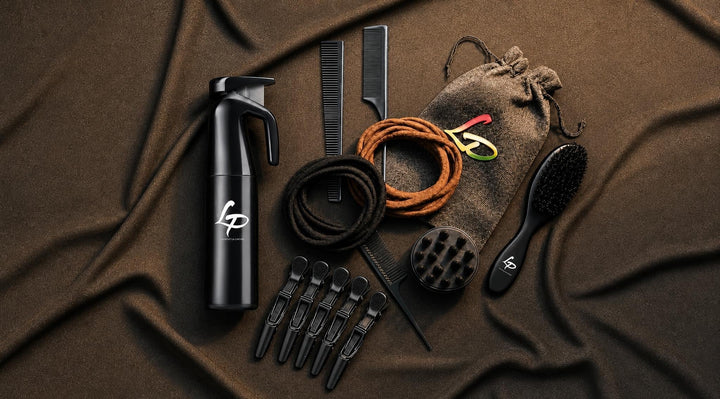
À chaque phase ses besoins. Le Kit Routine t'accompagne de la phase 1 à la maturité avec les 7 essentiels de l'entretien.
 The Essentials Locks PassionKit Routine
Discover
The Essentials Locks PassionKit Routine
Discover
Phase 2 - Consolidation (month 1 to month 6)
This is the most confusing phase and by far the most misunderstood. Locks swell, lose their initial definition, seem fuzzy or messy. This is normal: the hair cuticles begin to interlock with each other, creating an internal structure. From the outside, it looks like disorder. Inside, it is organization.
Do not compare your Locks in phase 2 to mature Locks on social media. This is the most common and discouraging comparison. Those Locks have 5 or 10 years of history behind them.
Common Mistakes in Phase 2
- Trying to redefine by handling too much
- Applying heavy products to "tame" frizz
- Comparing your Locks to others at different stages
- Giving up because the result is "not as expected"
Phase 3 - Closing (month 6 to month 12)
Locks begin to "close": their internal structure solidifies, ends consolidate, frizz gradually decreases. The result starts to look like what was imagined at the start. This is often the first truly rewarding phase.
Closing does not happen at the same pace on all Locks. It is normal to have some Locks more advanced than others on the same head. Consistent maintenance makes all the difference at this stage.
Phase 4 - Growth (year 1 to year 3)
Locks are closed, stable, and growing. This is the calmest phase of the journey. The routine is established, Locks require less attention, and results become increasingly visible. It is also the phase where Locks begin to reveal their true personality: their final texture, density, and unique behavior.
Routine During the Growth Phase
- Root maintenance every 4 to 8 weeks depending on the technique
- Regular washing 1 to 2 times per month
- Light hydration 2 to 3 times per week
- Systematic night protection
Phase 5 - Maturity (year 3 and beyond)
Mature Locks are fully consolidated, dense, with their final structure. They are more flexible, stronger, and paradoxically easier to maintain than in phases 2 or 3. This is the culmination of the journey, but also the beginning of a new chapter: mature Locks continue to evolve, grow, and change with their wearer.
Mature Locks are not built. They are earned. With time, consistency, and a lot of respect for the process.
Conclusion
The 5 phases of Locks are not obstacles. They are stages of a transformation. Each has its own beauty, challenges, and rewards. Knowing them before starting gives you the best chance to complete the journey.
Patience is not passive. In Locks, it is the most active gesture there is.