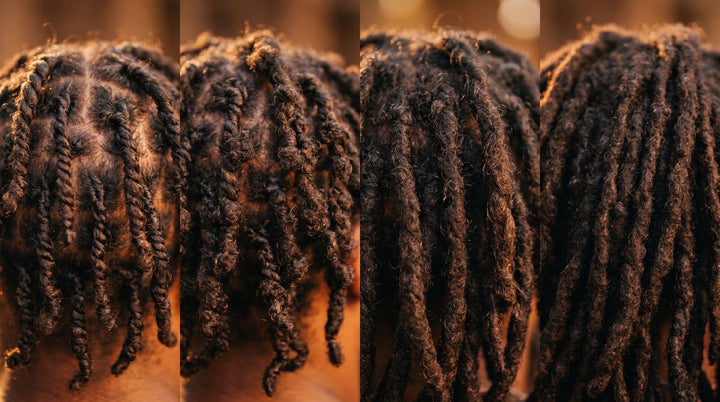
Child Locks Routine: The Complete Guide for Healthy Locks from an Early Age

Caring for a child's Locks is both simpler and more delicate than for an adult. Simpler because children often have hair that Locks easily. More delicate because their scalp is sensitive, their patience limited, and their hair habits are now being formed for years to come. This guide gives you a routine that is adapted, tested, and designed so that maintenance becomes a moment of care, not a moment of stress.
Specificities of Locks in Children
Children's hair is finer, more fragile, and more sensitive than that of adults. The scalp is also more reactive to unsuitable products. A child's Locks therefore require gentler products, more delicate handling, and a maintenance frequency adapted to their lifestyle (school, sports, outdoor play).
Absolutely avoid adult products on a child's scalp. Strong clarifying shampoos, heavy oils, and products containing strong fragrances are not suitable for children's hair and scalp.
How Often Should a Child's Locks Be Washed?
Usually more often than an adult's, because children sweat more, play outdoors, and their scalp is naturally more active.
Recommended Frequency According to Profile
- Less active child, no sports: every 2 to 3 weeks
- Active child, regular sports: every 1 to 2 weeks
- After swimming pool or sea: wash as soon as possible
- In case of persistent itching: increase frequency and consult if necessary
Washing Routine Adapted for Children
Washing a child's Locks is often easier with an inflatable basin: it allows control of water flow, prevents splashes in the eyes, and makes the moment more playful and less stressful for the child.
Washing Steps
- Prepare the space and the child before starting (comfortable posture, towel within reach)
- Wet the Locks and scalp with lukewarm water
- Apply a gentle shampoo suitable for children, gently massage the scalp with fingertips
- Rinse thoroughly until the water runs clear
- Gently press the Locks with a microfiber towel, without rubbing
- Dry completely before letting the child sleep
Pour le lavage des Locks d'un enfant, le Bassin Gonflable est la solution la plus confortable et la plus sécurisée : contrôle du débit, zéro éclaboussure dans les yeux, moment apaisé.
 The Essentials Locks PassionInflatable Pool
Discover
The Essentials Locks PassionInflatable Pool
Discover
Hydration of a Child's Locks
Children's Locks need hydration, but light. A spray based on water with a gentle natural active ingredient (aloe vera, floral water) applied 2 to 3 times a week on the lengths is sufficient in most cases.
Products to Avoid on a Child's Locks
- Thick butters and heavy creams (too occlusive for an active scalp)
- Mineral oils (block absorption)
- Products with strong synthetic fragrances (irritants)
- Unsuitable adult shampoos
- Products containing silicones
Night Protection: Essential from an Early Age
A satin night cap adapted to the child's head size is essential. It protects the Locks from friction against the pillowcase, retains hydration, and preserves maintenance work. It is a simple habit to integrate from the start: the earlier the child gets used to it, the more natural it becomes for them.
The night cap is not a constraint. It is a ritual. And children love rituals when they are well introduced.
Root Maintenance in Children
A child's Locks roots grow quickly. Maintenance every 4 to 6 weeks with a loctician is recommended to keep Locks clean and well-defined at the roots. Between sessions, avoid handling the roots too much at home to not weaken the bulbs.
Making Maintenance Pleasant for the Child
Tips for Stress-Free Sessions
- Announce the care time in advance, never unexpectedly
- Choose a time when the child is rested and in a good mood
- Play music or a cartoon during washing
- Simply explain what is being done and why
- Praise and encourage after each session
- Let the child participate (hold the towel, press the spray) so they take ownership of their routine
Conclusion
A child's Locks routine is easy to implement when it is adapted to their age, lifestyle, and scalp sensitivity. Gentle products, delicate handling, systematic night protection, and regular sessions with a loctician: these four pillars are enough for healthy, beautiful, and lasting Locks from an early age.
Caring for your child's Locks is teaching them early to cherish their crown.